top of page

How I discovered DNS Training and Found Pain-Free Riding

Introduction

If you have ever ridden through pain, you know how exhausting it makes you feel, and how discouraged you can become when nothing you do keeps the pain away.
I have been riding and training horses for decades and as so many horse riders, I experienced daily episodes of pain, that have made it hard to balance my passion for riding with my effectiveness in the saddle. Over the years, I tried various therapies (the list is very long!), yet the medicine cabinet with the pain medication grew ever larger. In my despair, about two years ago, I even had ultrasound guided steroid injections into areas around my worst affected hip. However, nothing gave me lasting relief.
By chance, I came across DNS training, started researching and immediately was hooked. Maybe it made immediate sense to me, so much of its underlying principles being similar to the way I approach and teach horse training. Since I had nothing to loose but everything to gain, I immediatly signed up for some more involved training and immersed myself fully into this modality, both to learn and practice the exercises for myself and to be able to help others. DNS helped me understand how my body moves, restore proper stability, and enabled me to ride without pain. Now, I am even more passionate about bringing this approach to New Zealand and sharing with other riders, athletes of other sporting codes, people recovering from various injuries or those simply wanting to move better and with more ease.


  • Me on my stallion Paseo II
    Me on my stallion Paseo II

What Is DNS Training?

Dynamic Neuromuscular Stabilization (DNS) is a rehabilitation and movement method developed by the Prague School of Rehabilitation that focuses on restoring natural movement patterns based on how our bodies are designed to function from birth.
Instead of isolating muscles, stretching or strengthening endlessly, DNS works on posture, breathing, and core stability as an integrated system. The goal is to retrain your nervous system so your body moves efficiently and automatically with less strain on and off the horse.
DNS taught me to move from the "inside out". Through simple exercises, emphasising quality over quantity, I improved my alignment, my breathing (which I thought wasn't bad at all, considering I have been doing regular yoga for almost a decade), activated my core for better stability (which also wasn't all bad considering it is one of a rider's most important tools) and freed up my lower back and hip areas.


What I learnt from my first DNS Sessions?

My first DNS session was something of an eye opener. Since my introduction to DNS was via an educational event, rather than an assessment through a therapist or exercise trainer, I was introduced to the exercises without a personalized initial assessment. As happens so often if you are pushed outside your comfort zone and have to learn something different, your brain tries to find similarities to feel comfortable. My brain immediately went into "oh this is like XYZ yoga pose" or "ok, I got this" remembering something I had done in Pilates or at the gym and muscling myself through a few sets of repetitions of some similar movements and positions, or trying to show the best yoga stretch I could muster to show my flexibility.
However, DNS sessions focus on movement quality, posture and breathing, rather than isolating muscle work or repetitive exercises. So instead, we evaluated the quality of the whole body stability strategy and scanned your own body looking for compensations or dysfunctional patterns that cause pain or limit movement or performance. Instead of heavy weights or high reps, we practised slow, controlled movements with precise alignment. A lot of emphasis is put on awarness and ease of movement, to retrain your nervous sytem for efficieny and ultimately creating LONG LASTING SUBCONSCIOUS changes.
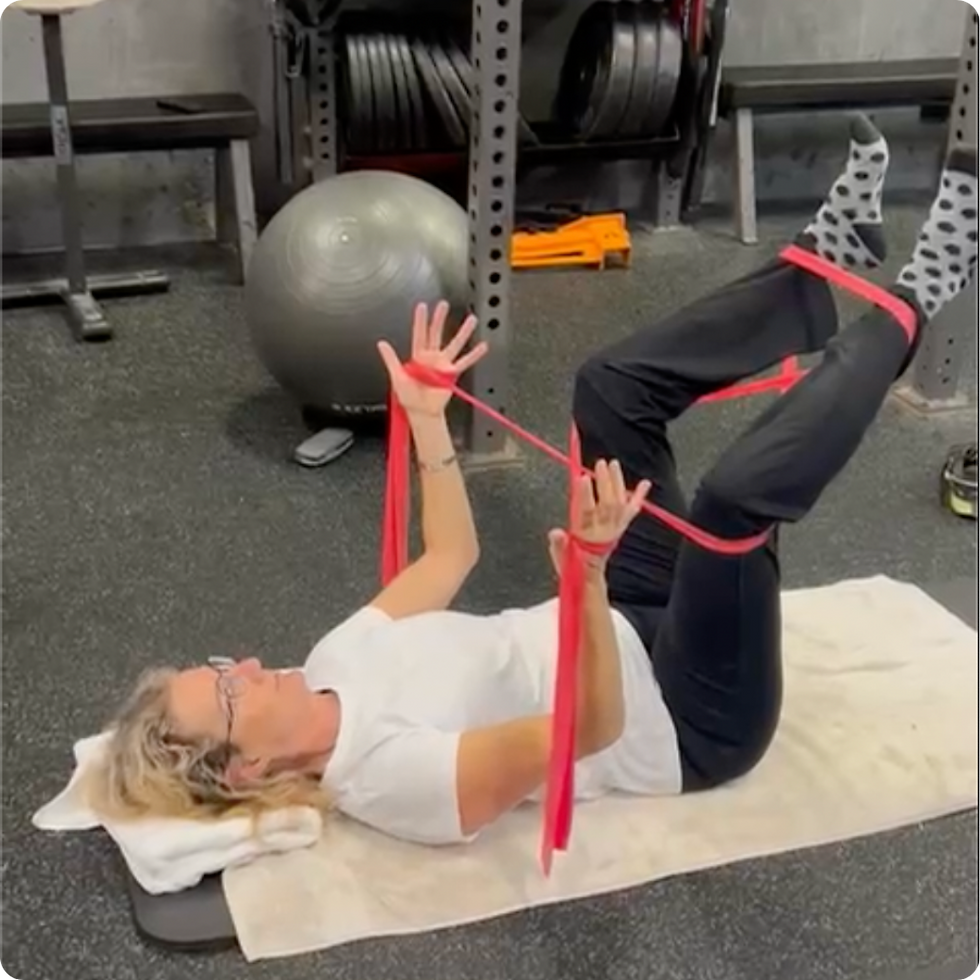
  • A more challenging DNS practice
    A more challenging DNS practice

Why Pain Happens for Many Riders

Us riders are like our own horses, we do not like to show pain. If we have an injury or after childbirth, the first thing we ask our doctor or therapist is when we can ride again. We also get trained to "get up and brush yourself off" and "to get straight back on the horse again" if you fall off. As a child, when I did come off, I did my best to show no pain at all, so my parents would not worry and prevent me from getting back on the horse. Chances are, by the time you get into your 40s, 50s 60s etc, your body is starting to have at best only a few "niggles" or at worst shows the effects of various injuries and compensation patterns. Lately, whilst thankfully not having to face this option myself, I hear of more and more riders who are trying to come back after joint replacements too.
So no wonder we suffer from pain!
There are 3 main areas which cause "pain" to happen: 1) Poor Core Stability which leads to overloading of hips and lower back. Yes, you are reading this correctly. Riders have deficiencies with their core stability - a lot! Its is not about that we are not using our "core", but all about not knowing and never being taught correctly HOW to use our core properly 2) Limited hip and lower back mobility which restricts the ability to follow the horse's movement. This in turn leads to a whole host of issues, not just for the rider's body but for the horse as well. 3) Breathing dysfunction which affects posture and balance in the saddle.
Traditional fixes like stretching tight muscles or strenthening weak ones, visiting various therapists to "put you back into alignment" do not work. They do not address the root cause, so a few days after your session, your body simply goes back into its old habitual pattern. This is exactly what happened to me and that keeps you in a perpetual pain cycle.


How I Feel After A Few Months

This has been the absolute GAME CHANGER.
I have been doing a few easy exercises each day for 5-10 minutes. At times, they feel so easy that it is hard to believe they have any effect at all. But far from it, my body now just does things with ease and not just is my hip pain gone completely, I have found balance, stability and strength in areas that previously had stubbornly prevented me from improving.
I had just about given up, thinking to limit myself to certain periods of riding, however, now I feel well and able enough to stretch myself into areas I had previously thought impossible.

How to Integrate DNS Into Your Riding Routine

Practice your DNS specific exercises for a few minutes daily - off the horse.
Whilst riding, especially during the warm up, think about your alignment, breathing and stability as practiced off the horse previously.
Stay consistent, practice small regular steps and go back to earlier exercises off the horse when needed.


How YOU Can Integrate With Other Modalities

You do not need to ditch your favorite physiotherapist, osteopath or chiropractor and you should still do your fitness and strength training. But armed with what you learn with DNS, all these modalities are now enhanced, as will be the outcomes of your regular riding training.
DNS training is highly adaptable and can complement many other approaches to improve overall rider health and performance. Because DNS focuses on restoring ideal movement patterns, breathing, and core stability, it enhances the effectiveness of other therapies rather than replacing them.

Conclusion

Life pushes you into certain directions at times, and branching out into learning all about a human centred exercise therapy, after a life-long career centred around health, wellbeing and biomechanically correct horse training, has not just been hugely rewarding but feels like closing a circle that was just out there ready for me to complete.
I feel as if I have found a hugely significant piece missing in my puzzle. The puzzle that completes the picture of a balanced dynamically stable and efficient rider, enabling a balanced and dynamically stable horse, both performing in harmony - all you passionate fellow horse riders will understand this picture. Being able to practice to achieve this picture and doing so without pain and restriction, this is what DNS is showing me!

What Can You Do?

Have you tried DNS training? I would love to hear how it has helped you! Whether it improved your posture, reduced pain, or made you feel more connected in the saddle, share your experience in the comments below. Your story could inspire another rider to start their own journey toward pain-free, balanced riding!
If you want to know and learn more, contact me to help you identify weaknesses, improve your position, and prevent injuries before they start. Book an in-person assessment via my "bookings" tab. Techniques like DNS, posture training, and tailored exercise programs are most effective when guided by an expert who understands both biomechanics and riding.
Alternatively, check out my first ever DNS-based rider specific online course.


Comments


bottom of page